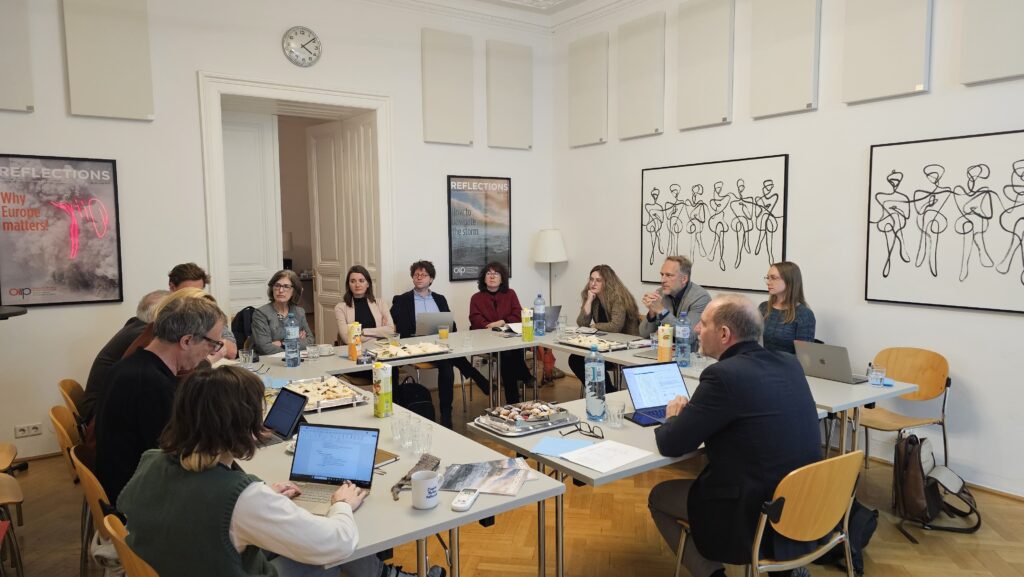
Vienna, 14 January, 2026 – A closed-door policy discussion held in Vienna as part of the REUNIR project, organized with the Centre for Southeast European Studies (CSEES) and the support of the Austrian Institute for International Affairs (OIIP), brought together 14 experts to assess the next steps in the European Union integration of the Eastern Neighbourhood and Western Balkan countries.
Participants compared political and security trends across the two regions and explored what 2026 could mean for regional stability, democratic resilience, and the future of EU enlargement.
Intensifying hybrid pressure and competing models
The discussion highlighted that hybrid pressure is intensifying across both regions. Disinformation, cyberattacks, vote manipulation, and “values-based” propaganda are increasingly deployed as core instruments of influence, often framed as a clash between “traditional” and “Western” values.
Participants also underlined the growing role of external actors such as Russia, China, Turkey, and Gulf states. These actors promote alternative governance and investment models, often through sector-specific leverage, particularly in the energy sector and targeted political partnerships. Their influence does not always appear in headline foreign direct investment figures, but can still be highly impactful.
Growing resilience gaps and perceptions of EU impact
Despite formal progress toward EU integration, several countries in the Eastern Neighbourhood and Western Balkans continue to face serious vulnerabilities. The discussion noted that being labeled a “front-runner” in the enlargement process does not necessarily translate into stronger societal or institutional resilience.
At the same time, the EU’s impact in the region is often perceived as slow, cautious, and difficult to pin down. Participants described the EU as incremental and less innovative compared to other actors that move faster with clearer sectoral offers.
The role of the United States becoming more transactional and selective, with a stronger focus on business and strategic interests, especially in the energy domain and comparatively less emphasis on constitutional order. This has created a perceived mismatch with EU priorities.
Pivotal tests and shifting enlargement debates
Participants identified Serbia and Bosnia and Herzegovina as pivotal test cases for the credibility of the EU’s enlargement approach. Several argued that if the region cannot effectively address its most challenging cases, this will signal broader limits in the EU’s capacity to respond to larger geopolitical challenges.
The debate on enlargement itself is also shifting. While “merit-based” accession remains the official framework, participants questioned whether “doing the homework” is still sufficient at a time when liberal democracy is under sustained pressure. There is a concern that the “rule of law” risks are turning into a buzzword unless supported by consistent enforcement and credible incentives.
2026 as a decision year: risks and opportunities
The discussion framed 2026 as a potential decision year for the credibility and direction of EU integration in both the Eastern Neighbourhood and Western Balkans. Momentum could shift quickly, depending on internal EU politics and developments on the ground in partner countries, either toward renewed credibility and engagement or toward deeper drift and disillusionment.
Participants identified key risks, including democratic backsliding, state capture dynamics, deeper dependency through energy and infrastructure projects, and continued fragmentation between EU and US approaches.
At the same time, they noted important opportunities: potential political shifts within the EU that could reshape enlargement dynamics; emerging civic energy in parts of the region; and the continuing reality that the EU remains the only actor capable of providing a comprehensive long-term package of reforms, funding, and standards.
The discussion formed part of the REUNIR project’s broader efforts to generate nuanced, evidence-based debate on the future of EU relations with its Eastern Neighbourhood and the Western Balkans.