
Author: Dr. Nejra Veljan is a project manager and researcher at the Atlantic Initiative. She holds a PhD from De Montfort University, an MA in Security Studies, and an LLM from the University of Sarajevo. Her work focuses on postconflict governance, violent extremism, and security cooperation in Bosnia and Herzegovina and the Western Balkans.
“I have to have the capitals’ broad agreement with what I do,” Paddy Ashdown once said of his role as incumbent of the Office of the High Representative (OHR) in Bosnia and Herzegovina. It was a revealing admission. Even at the height of the OHR’s power, the authority of the office rested not only on the Dayton Agreement or on the Bonn Powers, but on the cohesion of the international actors behind it.
That is why Christian Schmidt’s announced departure as High Representative should not be read as an isolated personnel change. It is the latest expression of a deeper structural problem. Bosnia and Herzegovina is still treated as a state that requires international oversight, while the Western actors most responsible for that oversight no longer share a clear strategy for moving from supervision to democratic domestic authority.
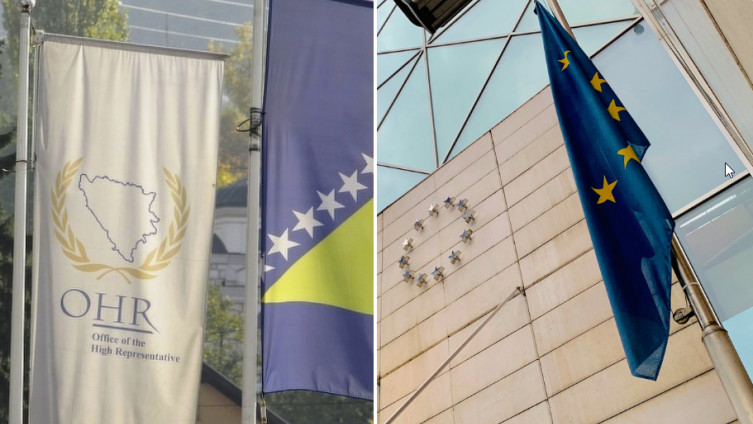
The argument is therefore simple: Bosnia’s OHR problem is not only a legal or institutional problem; it is a Western strategy problem inside the Peace Implementation Council (PIC) Steering Board, whose members include Canada, France, Germany, Italy, Japan, Russia, the United Kingdom, the United States, the Presidency of the European Union, the European Commission, and the Organisation of Islamic Cooperation, represented by Turkey.
Bosnia and Herzegovina is often discussed as if its political life began in Dayton. This remains one of the most persistent mistakes in Western thinking. Dayton ended the war, but it did not create Bosnia and Herzegovina, its sovereignty, its political identity, or its long history of coexistence across religious, cultural, and imperial borders. Yet many Western strategies have treated Bosnia and Herzegovina as a postwar problem to be managed, instead of a historic polity whose sovereignty had to be protected from old and new forms of geopolitical contestation.
Geopolitical dependency
The Office of the High Representative was created to oversee civilian implementation of the Dayton Peace Agreement. It was not designed to become a permanent feature of Bosnia’s political system. Yet from its origins in Annex 10, the OHR carried an unresolved tension: the office was expected to support Bosnia and Herzegovina’s democratic development while remaining dependent on the political calculations of external powers. It was placed inside Bosnia’s political order, but its authority came from outside it.
What emerged over time is a condition of geopolitical dependency. Bosnia’s institutional development became tied not only to domestic democratic processes, but also to the changing will, cohesion, and strategic interests of external actors. An institution created to help Bosnia and Herzegovina become a self-governing democracy also made the country vulnerable to priorities set in capitals that are not accountable to Bosnian citizens.
Four geopolitical shifts in the OHR’s authority
The OHR’s practical authority evolved through four shifts in external political backing: ambiguity, empowerment, fragmentation, and contestation.
The first shift was visible in the drafting of Annex 10. The OHR was created as the final authority for civilian implementation of Dayton, but the scope of that authority was contested from the beginning. European actors generally wanted a stronger international mechanism to oversee implementation, while the United States was hesitant about creating an overly powerful civilian office. The result was an institution whose mandate was broad enough to matter, but ambiguous enough to be reinterpreted later.
The second shift came at the Bonn meeting in 1997. Frustrated by obstruction and slow implementation, the United States became one of the main supporters of a stronger OHR. The Bonn Powers transformed the High Representative from a supervisor of civilian implementation into an executive actor with the authority to impose binding decisions and remove public officials. The OHR was actively shaping the Bosnian state.
This practice peaked under Paddy Ashdown. Backed by a relatively united international community, the OHR pushed through reforms that domestic political actors resisted. His tenure became the apex of the interventionist model and revealed the contradiction of the post-Dayton order: Bosnia and Herzegovina was being moved toward democratic self government through decisions made by an unelected international official whose authority depended on external capitals.
The third shift became visible after 2006, following the failure of constitutional reform and the growing emphasis on local ownership. The OHR remained formally powerful, but the political consensus behind its use weakened. The European Union increasingly treated accession as the main mechanism for transforming Bosnia and Herzegovina, while the United States reduced its everyday engagement. Russia became more willing to challenge the legitimacy and authority of the OHR from within the very framework that had sustained it. The result was not the disappearance of international power. It was its fragmentation.
A revealing episode occurred during the 2007 crisis over Miroslav Lajčák’s measures on decision-making in the Council of Ministers and Parliamentary Assembly. The PIC Steering Board publicly supported the High Representative and called on Republika Srpska’s leaders to respect their obligations, but Russia resisted that wording and was allowed to attach a special opinion. In that note, Moscow argued that the measures changed decision-making procedures without agreement among Bosnian leaders and should be developed in a more stable context. This was a small diplomatic device, but it mattered. It showed that Russia could remain inside the postwar architecture while using that same architecture to narrow the political room for OHR action. From that moment onward, PIC Steering Board communiqués, the main public expression of political consensus and guidance for the OHR, were increasingly accompanied by Russian footnotes, reservations, or separate opinions. The appearance of international unity around the High Representative had begun to fracture.
The fourth geopolitical shift became more pronounced after 2014. Russia’s annexation of Crimea and the weakening of the liberal international order changed the environment in which the OHR operated. Russia’s position inside the PIC Steering Board became more openly contestatory, while Western actors continued to speak of Bosnia and Herzegovina’s European future without the unity needed to protect it.
The OHR’s authority has always reflected the wider geopolitical balance among external actors. When the international community was united, the High Representative had room to act. When that unity fractured, the OHR became more cautious, more contested, and more exposed to domestic obstruction. The PIC Steering Board was the arena through which global shifts entered Bosnia and Herzegovina’s political life.
Regional power, not only technical governance
This history cannot be understood outside Bosnia and Herzegovina’s longer political trajectory. Bosnia did not enter Dayton as a state without history, nor as a territory whose sovereignty began with international supervision. Dayton interrupted one violent attempt to destroy Bosnia and Herzegovina, but it also created a postwar order in which that sovereignty remained exposed to external interpretation.
Serbia and Croatia remained direct signatories of Dayton, neighbouring states, and active claimants in Bosnia and Herzegovina’s constitutional debates. The international community was not decisive enough to curb these regional forces. Serbia’s political space allowed the idea of the Serbian World to expand, often overlapping with Russian interests and anti-NATO narratives. Croatia, as a member state, used EU institutions and diplomatic channels to shape debates about Bosnia and Herzegovina from within the European integration project itself. These pressures are not identical, but their consequence is similar: they make Bosnia and Herzegovina’s sovereignty appear conditional and available for external bargaining.
Western strategy too often treated Bosnia and Herzegovina as a technical governance problem. Reform, functionality, electoral rules, conditionality, and local ownership all matter. But when detached from the regional power context, they make Bosnia’s crisis appear as a problem of domestic institutional design alone. In reality, obstruction inside Bosnia and Herzegovina has repeatedly been strengthened by neighbouring state projects, Russian support for anti-Western actors, and Western reluctance to impose clear costs on those who undermine the state.
The OHR should therefore be read as more than a legal anomaly. It is also one institutional site where power is narrated, contested, and made operational. International politics is never neutral in its language. In Bosnia and Herzegovina, the vocabulary of peace implementation, local ownership, European integration, and stability shaped what international actors considered possible. It also shaped what domestic actors learned they could get away with.
This is the familiar dilemma of international state-building. External authority is justified as temporary and exceptional, but the longer it remains, the more it reshapes the political field it was meant to stabilise. Through the OHR, global shifts became tangible in Bosnia and Herzegovina through one institution, one mandate, and one diplomatic arena located inside the state whose future was being debated.
Schmidt’s departure and the new American recalibration
Schmidt’s departure is the latest instance in a longer process in which geopolitical shifts have repeatedly reflected back onto the OHR. What makes the current moment different is that the shift is no longer only about Russia’s contestation or Europe’s hesitation. It is also about American recalibration.
The practical details matter. Reporting around Schmidt’s resignation has linked the episode to pressure over the Southern Interconnection gas pipeline and a wider American preference for a more limited successor role. Whatever is ultimately confirmed or contested, the signal is clear. The future of the OHR is being debated through constitutional language, energy infrastructure, regional bargaining, and American repositioning.
That change does not remain in Washington. It travels through the PIC Steering Board, through the appointment of the High Representative, through the expected mandate of any successor, through the use or nonuse of the Bonn Powers, and finally into the domestic political calculations of actors in Bosnia and Herzegovina.
Schmidt’s departure therefore marks the culmination of a much older process. Bosnia and Herzegovina remains under international supervision, but the Western actors responsible for sustaining that supervision no longer share a clear political project. The EU speaks of accession, but often treats Bosnia and Herzegovina as an administrative file. The United States has moved between strong engagement, strategic distraction, and now apparent recalibration. Russia abandoned the old consensus years ago. Serbia and Croatia project influence through different languages, but both keep Bosnia and Herzegovina’s sovereignty open to external bargaining.
The paradox is stark. Bosnia and Herzegovina is still treated as a state that requires international oversight, while the oversight itself is increasingly fragmented. The OHR has become both a tool of international state-building and a mirror of international disorder.
The transition problem
Debates about whether the OHR should stay or go can therefore be misleading. The more difficult issue is whether there is a credible strategy for moving from international supervision to democratic domestic authority without allowing those who undermine the state to capture the transition.
Closing or weakening the OHR without such a strategy would not automatically create democracy. It would remove one of the remaining safeguards while leaving the same political incentives in place. In a system where obstruction is rewarded, secessionist threats are normalised, and foreign actors can use domestic divisions for their own purposes, institutional withdrawal without political design is not reform. It is a risk.
Defending the OHR as if it can solve Bosnia and Herzegovina’s democratic crisis is equally mistaken. The OHR can stop certain crises, correct some legal blockages, and impose decisions when domestic actors refuse to act. It cannot create democratic accountability, rebuild trust, or replace a political culture based on permanent crisis.
That is the trap. The OHR cannot be permanent. Its disappearance, if unmanaged, would not be democratic maturity. It would be a vacuum.
Western strategy has failed most clearly in this space between supervision and transition. For years, Western actors defended Bosnia and Herzegovina’s sovereignty while tolerating attacks on state institutions. They supported EU integration but allowed accession to lose political force. They warned against malign foreign influence but failed to maintain the unity needed to counter it. Russia understood this weakness particularly well. By questioning the legitimacy of the OHR, opposing Bosnia and Herzegovina’s NATO path, and supporting actors who challenge the state, Moscow used Dayton’s unresolved structure as a pressure point against the West.
Therefore, the OHR cannot be discussed only as a legal institution. It must be understood as part of a wider geopolitical structure. If that structure is divided, the office becomes vulnerable. If the office becomes vulnerable, domestic actors learn that international red lines are negotiable. Bosnia and Herzegovina’s democratic future then becomes conditional on the calculations of actors who do not necessarily want it to succeed.
What a serious Western strategy would require
A serious Western strategy would begin by accepting that Bosnia and Herzegovina’s EU path is a question of democratic resilience, regional security, and sovereign equality. The EU cannot credibly promise membership while allowing the country’s institutional order to be weakened by actors who reject the political direction that accession requires. The United States cannot treat Bosnia and Herzegovina as a secondary issue to be managed through temporary deals that reshape the balance of power around the OHR.
Such a strategy would require several shifts. Western actors would need to speak about Bosnia and Herzegovina’s sovereignty not as a post-Dayton formula, but as a historical and political fact. The EU would need to treat accession as a political and security priority. The United States and the European Union would need to avoid working from different scripts. The OHR would need to be understood as part of a transition strategy, not as a substitute for one. Regional actors would need to hear a clear message: Bosnia and Herzegovina is not a space for compensating Serbian, Croatian, Russian, American, or European anxieties.
Bosnia and Herzegovina’s citizens should not be treated as spectators in a geopolitical contest. The language of stability has too often empowered elites who produce instability. Real resilience comes from institutions, civil society, independent media, accountable politics, and the belief that democratic choices matter.
Beyond the interregnum
Bosnia and Herzegovina’s postwar order increasingly resembles Antonio Gramsci’s famous description of an interregnum: the old is dying, but the new cannot yet be born. The OHR was supposed to belong to the old order of postwar supervision. EU accession was supposed to represent democratic transformation. Today, Bosnia and Herzegovina is trapped between the two. Weakening the old without making the new credible is not transition. It is drift.
The OHR should eventually become unnecessary. It should become unnecessary because Bosnia and Herzegovina’s institutions are stronger, its EU path more credible, and its democratic safeguards more secure. It should not become unnecessary because external actors have lost interest, because Russia wants it gone, because regional actors find it inconvenient, or because Western capitals prefer the appearance of stability over the hard work of strategy.
If Western actors want Bosnia and Herzegovina to move beyond the OHR, they must first answer the question they have avoided for too long: what kind of Bosnia and Herzegovina are they willing to support, and what political cost are they prepared to impose on those who work against that future? Until that question is answered, every debate about the position of the High Representative will remain a symptom of the same deeper problem. Bosnia’s OHR problem is really a Western strategy problem.
Photo credits: OHR Official Website