Author: Apostolos Thomadakis, Senior Research Fellow at CEPS
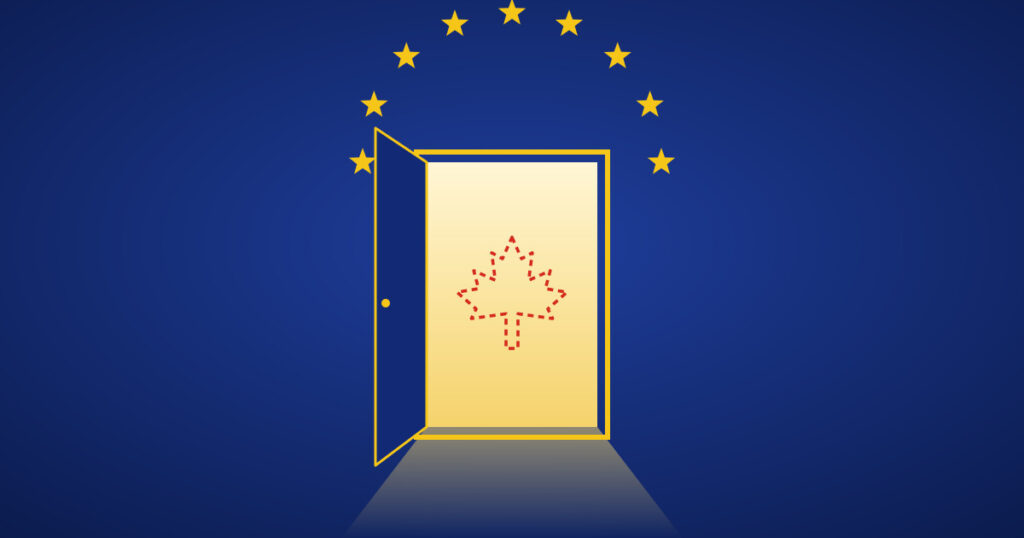
In her State of the Union address, Commission President Ursula von der Leyen made one of the most significant statements of the speech in just one sentence. Having set out an ambitious agenda for closer cooperation with Canada, she suggested ‘opening the door for Canada to be the first associate member of the EU’.
There is a strong geopolitical rationale for closer EU-Canada relations. The two are already connected through agreements such as the Comprehensive Economic and Trade Agreement (CETA), and increasingly share interests in defence, critical raw materials, energy, technology, AI, economic security and the Arctic. Against a backdrop of growing geopolitical fragmentation, there is every reason to explore how this relationship could be deepened.
But ‘associate membership’ is a different matter. The term raises fundamental questions about what kind of relationship is actually being proposed – questions that become all the more important because no such category of EU membership currently exists under the Treaties.
A label without a legal status
Article 49 of the Treaty on European Union (TEU) provides that a European state may apply to become a member of the Union. Canada is obviously not seeking membership and, in any event, Article 49 limits eligibility for EU membership to European states. The Canadian reaction to von der Leyen’s proposal was also more reserved about the label. While Prime Minister Mark Carney welcomed the prospect of a much stronger relationship he kept on calling the objective a ‘unique alliance’ or a ‘unique approach’, rather than a membership in an institutional sense. Canada is interested in the substance of a closer cooperation but not necessarily in the implications that come with the language of membership.
The Treaties do provide another route. Under Article 217 of the Treaty on the Functioning of the European Union (TFEU), the Union may conclude association agreements with third countries involving reciprocal rights and obligations, common action and special procedures. Such agreements can provide for very deep forms of cooperation. The EU–Ukraine Association Agreement, for example, combines political association with economic integration, including a Deep and Comprehensive Free Trade Area, regulatory approximation and gradual access to parts of the EU’s internal market. But an association agreement, however extensive, does not in itself confer any form of membership of the European Union.
This does not mean that the idea of associate membership is new. In May 2026, German Chancellor Friedrich Merz proposed granting Ukraine the status of ‘associate membership’ as an intermediate step towards full membership of the EU. The proposal envisaged closer institutional participation, including in certain meetings of the EU institutions without voting rights, but without deviating from the formal accession process. The use of this term, however, is meaningfully different from that in the Canadian case: Ukraine is a European candidate country, which seeks full membership, whereas Canada is neither eligible nor intends to become a member of the EU under Article 49 TEU.
Earlier, a 2023 Franco-German report by an independent Working Group on EU Institutional Reform envisaged a Europe organised in four concentric circles, including an ‘associate membership’ tier between full EU membership and the European Political Community. Associate members would participate in the Single Market and adhere to common principles, without being bound by the objective of ‘ever closer union’. But this remained a proposal rather than an established legal or institutional status.
The ambiguity is not merely legal. The prospect of granting Canada a special status had already prompted reservations in some Member State capitals before the State of the Union address, including questions about the case for preferential treatment and whether closer relations could instead be pursued through existing arrangements. Von der Leyen has now elevated ‘associate membership’ into a political objective without there yet being a common understanding of what that status would entail.
So what does von der Leyen mean by ‘associate membership’ in this case? Would Canada participate in parts of the Single Market and align with the relevant EU acquis, or would the relationship instead rely on more limited forms of market access based on regulatory cooperation and mutual recognition? Would associate membership cover defence procurement, energy, critical minerals, research and AI, but not the four freedoms? Would Canada contribute to the EU budget or participate in EU programmes? Would it have any form of representation in EU institutions or agencies? Would it have consultation rights, or even some form of participation in decision-making in areas where it accepted EU rules? And what obligations would Canada assume in return?
These are not technical details to be settled after the term has been announced. They define the substance of the proposed relationship.
EU à la carte?
There is a broader issue at stake. Is the Commission opening the door to a new form of Europe à la carte?
The attraction is understandable. In a world where the boundary between the EU’s internal and external policies is becoming increasingly blurred, a binary choice between full EU membership and conventional third-country relations may be too restrictive. Close partners may want deep integration in defence, research, energy, technology or parts of the Single Market without becoming EU members.
Differentiated integration is hardly new. Not every EU Member State participates in every part of the integration project, while countries outside the Union already participate deeply in parts of the European economic and regulatory system.
But ‘associate membership’ would take this logic into much more politically sensitive territory.
The European Parliament has described “Europe à la carte” as a model in which Member States choose policy areas in which they wish to participate while retaining only a minimum number of common objectives. It has also warned against differentiated integration turning into à-la-carte participation. Moreover, proposals to distinguish between full and associate EU membership have previously arisen in discussions about Treaty reform.
This makes the Canadian proposal potentially much bigger than Canada itself. If Canada can become an associate member, why not the United Kingdom? What would distinguish this status from Norway’s participation in the EEA or Switzerland’s relationship with the EU? Australia and New Zealand have already been mentioned as other countries that could potentially follow Canada. Where, then, would the boundaries of this new form of association be drawn?
More importantly, what message would it send to countries that actually want to join the European Union? Ukraine, Moldova and the Western Balkan candidates are undertaking difficult reforms and accepting extensive EU conditionality with the objective of achieving full membership. Creating a privileged new status for a wealthy third country could raise difficult questions, particularly if it allowed participation in selected areas without assuming comparable obligations.
The Union would therefore need to distinguish clearly between three very different possibilities: associate membership as a geopolitical partnership for countries that cannot or do not wish to join the EU; as a pre-accession status for candidate countries; or as a permanent outer tier of European integration.
Rights without obligations – or obligations without representation?
There is another familiar European integration dilemma behind the proposal. The more deeply a third country participates in EU policies and markets, the harder it becomes to avoid the relationship between market access, regulatory alignment and political representation.
If Canada is to gain extensive market access while remaining free to diverge from EU rules, Member States and other partners could reasonably ask why comparable flexibility was not available to them. But the opposite model also creates problems. If Canada were required to comply with EU rules in areas covered by associate membership without having a meaningful role in shaping those rules, the arrangement would reproduce the familiar problem of rule-taking without representation.
Labelling this arrangement ‘associate membership’ does not solve the trade-off in question.
Nor can the Union assume that shared values eliminate regulatory differences. Canada remains highly economically integrated with the United States. Around 72% of Canadian exports still go to the US, while important regulatory and market-access differences with the EU remain, including in areas such as agriculture and telecommunications.
Deeper integration therefore requires choices, not simply declarations of political affinity.
Start with the objective, not the label
The strategic case for closer EU-Canada relations is strong. Europe requires closer cooperation with those countries with which it shares important economic, security and democratic interests. And Canada is an ideal candidate.
However, the proper logic should be quite the opposite. First, the EU should define what it wants to achieve through deeper integration with Canada, in which fields, with what reciprocity of rights and obligations, and through what institutional framework. Then, it can define what legal arrangement will be appropriate for such relationship – and how it should be named. The objective may ultimately be better described as an ‘integrated partnership’ rather than ‘associate membership’. But that too should follow from the substance of the relationship, rather than determine it in advance.
This matters particularly because ‘membership’ has a specific meaning in the EU. It implies much more than an advanced partnership: a set of rights and obligations, participation in common institutions, acceptance of the EU legal order and membership of a common political project.
If ‘associate membership’ does not imply these characteristics, the Commission should explain what distinguishes it from an advanced association agreement or strategic partnership. If it implies something more, its institutional and potential Treaty implications should be stated openly.
A new architecture for relations between the EU and its closest partners may well be worth considering. But without greater clarity, ‘associate membership’ risks blurring rather than clarifying the boundaries between membership, association and strategic partnership.
Before opening the door to the EU’s first ‘associate member’, Europe should first decide what exactly lies behind that door.