Commentary by Iulian Groza, Executive Director, Institute for European Policies and Reforms (IPRE)
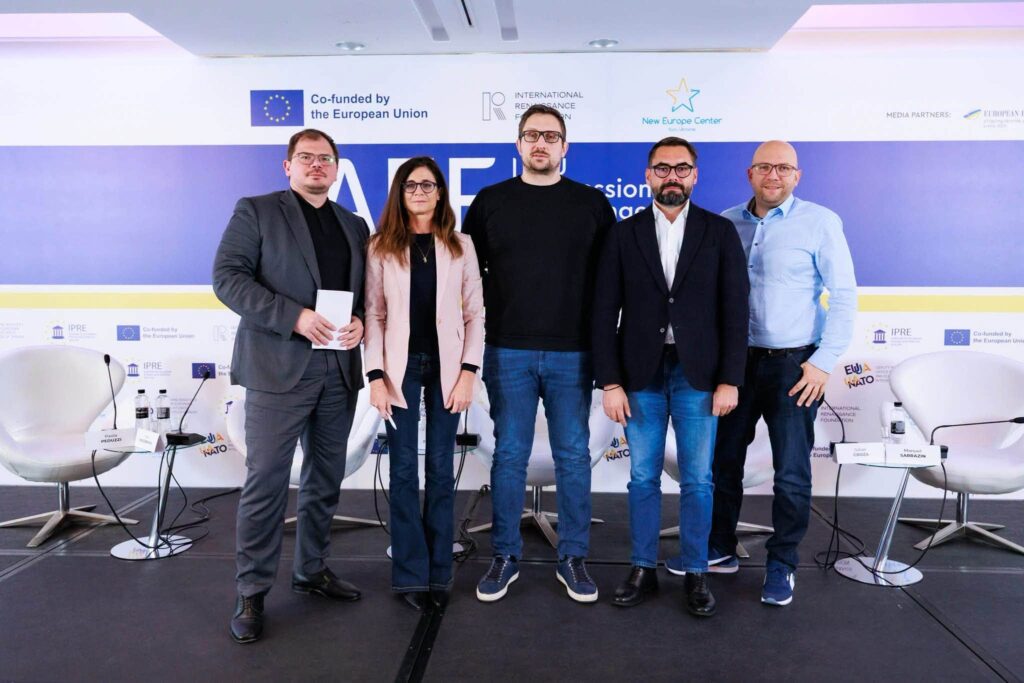
On 4th November 2026, the day the European Commission published the Enlargement Package and the indicative roadmaps for the Republic of Moldova, Ukraine, Albania and Montenegro, I was in Kyiv for the 5th EU Accession Exchange Forum, organised by the New Europe Center in partnership with the Institute for European Policies and Reforms.
On the panel moderated by Paola Peduzzi (Il Foglio), alongside Ivan Nahorniak (European Policy Institute in Kyiv – EPIK), Manuel Sarrazin, Senior Advisor of the Deputy Prime Minister for EU integration of the Republic of Moldova, Strahinja Subotić (European Policy Centre/Centar za evropske politike – CEP) and Andrii Borovyk (Transparency International Ukraine), I shared a few messages on what matters most in Moldova’s EU accession negotiations.
The calendar matters. The roadmaps set an important horizon. 2028 is the year our countries have committed to, with the support of the European Commission, for provisionally concluding negotiations: early in the year for Moldova, by the end of the year for Ukraine. The Commission is looking for solutions to advance the accession negotiations under enlargement policy, where it has a clear mandate. Despite blockages in the Council and other challenges, enlargement continues. Dates open doors and set horizons. We have a calendar, perhaps not as precise as we wanted, but one that aligns objectives, priorities and efforts in our countries, across the EU and together with the European Commission. The priority is to keep up the pace of the reforms we committed to in the negotiations. That is what the Commission’s “ambitious but achievable” for Moldova depends on.
Reforms are made at home. The biggest lesson we have learned is that reforms matter. They matter when they are delivered at home, not only when we tick boxes in Brussels. We have benchmarks and reforms to deliver, but they matter only when stakeholders in our countries take ownership of them and when they withstand electoral cycles. In Moldova, the justice sector and the rule of law have been and will remain one of the critical areas of reform. The vetting process has been particularly challenging, but it is moving forward because there is ownership at home and cooperation with partners in the EU.
Merit must withstand political vetoes. This is not only about Ukraine and the recent blockages in the Council, which held Moldova back too. Candidate countries in the Western Balkans have been waiting for progress because of political blockages and unresolved bilateral issues. This undermines merit, a key principle of enlargement policy. Solutions exist. Front-loading, meaning technical work on clusters before their formal opening, has been very important in keeping negotiations moving. And the Commission’s proposal to move to qualified majority voting for intermediate decisions in the negotiations could limit vetoes, if member states accept it.
We must all be realistic. No reform is irreversible. For reforms to last, reversing them must carry a cost and clear, immediate consequences. And any attempt to undo them must be visible from the start. That is why we need resilient, independent, honest and efficient institutions that keep reforms working and delivering results. Any future government will then inherit reforms it cannot undo without paying a price. The accession process gives countries like Moldova a clear roadmap for reforms, just as we had with visa-free travel. When we delivered those reforms and made them work, citizens felt the benefits.
What we deliver must also be communicated, well and tirelessly. Political and popular support for reforms, accession and enlargement is critical, in our societies but also in the member states. We tend to talk to decision-makers in Brussels and EU capitals, and at that level it works. But ratification comes last, in every member state, as the final step before accession. If we cannot reach communities, citizens and businesses, and get everyone used to the idea that we will be together, we will fail. So as we negotiate, open clusters and work towards closing negotiations, we need to go to communities in the member states, and think tanks can be the bridge.
#accessionforum2026 #ThinkTanks4EUMembership #MoldovaInEU