Nearly 2,000 scholars and researchers from across Europe and beyond have gathered in Lisbon for the 19th Pan-European Conference on International Relations (EISA PEC 2026), taking place from 1 to 4 September 2026 at ISCTE – University Institute of Lisbon.
Organised by the European International Studies Association (EISA), this year’s conference explores the theme “Even better than the real thing? Questioning knowledge production, positionality, and authenticity in International Relations.”
The four-day event brings together a record number of participants for a wide-ranging programme of panels, roundtables, plenary discussions, special events and early-career development activities. The conference programme includes hundreds of academic sessions across 66 sections, reflecting the breadth and diversity of contemporary International Relations research.
Among the wide range of discussions taking place at the conference, REUNIR researchers are contributing to the section “Enlargement in a State of War and Geopolitical Tensions,” which examines the European Union’s evolving neighbourhood and enlargement strategy in the context of Russia’s war against Ukraine, growing geopolitical tensions and changing patterns of external influence.
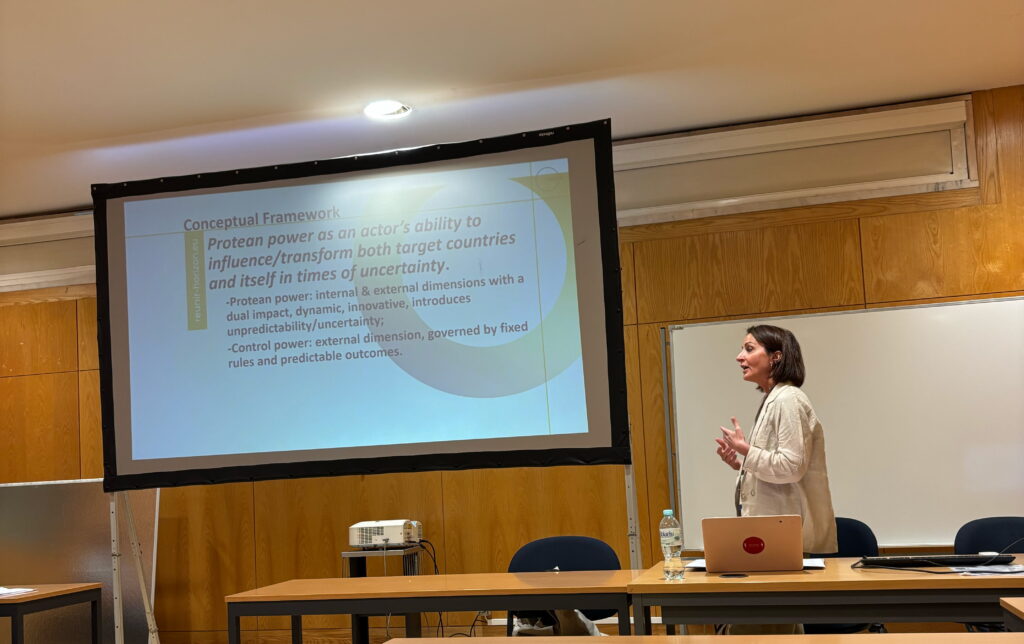
Within this section, Dr Tamar Gamkrelidze, Postdoctoral Fellow at the College of Europe in Natolin, is contributing to the panel “The EU and Eastern Enlargement” with her paper “Enlargement Reinvented: The EU’s Protean and Control Power in the Eastern Neighbourhood & Western Balkans” published in the European Foreign Affairs Review and examines how the EU’s enlargement strategy has evolved in the post-2022 security context, combining traditional control mechanisms with more adaptive forms of power.
Also contributing to the same section, Iulian Groza (Republic of Moldova) is participating in the panel “The Geopolitical Enlargement of the European Union” with his paper “Moldova and the Revived EU Enlargement Policy: Accession, Resilience, and Strategic Integration in Time of Geopolitical Shift.” His contribution explores Moldova’s European integration in the context of the EU’s revived enlargement policy and the broader geopolitical changes shaping the accession process. The paper will be published soon.