Author: Steven Blockmans, a Deputy Director and Head of the Foreign Policy Programme at the International Centre for Defence and Security (ICDS), Associate Senior Research Fellow at the Centre for European Policy Studies (CEPS), and Visiting Professor at the College of Europe (Bruges, Natolin, Tirana).
Although the Icelandic vote does not concern EU membership itself, its implications extend well beyond the mid-Atlantic island.
A positive result will sustain momentum behind EU enlargement and strengthen the Union’s geopolitical credibility at a time of growing uncertainty. A rejection, by contrast, will further reduce the EU’s stature on the international stage, reinforce scepticism towards enlargement, and provide additional arguments for opponents of a stronger EU and deeper European integration.
In 2009, a proposal by the Independence Party to hold a referendum on the question of whether or not to apply for EU membership was defeated by a single abstention in the Icelandic parliament. The August 2026 referendum is a first for Icelanders to express whether they want the government to resume EU accession negotiations after they were frozen in 2015.
“While domestic considerations remain central, recent geopolitical developments have transformed the debate”.
Opinion polls suggest an exceptionally close contest. Recent surveys indicate that Icelandic society remains almost evenly divided, reflecting long-standing disagreements over sovereignty, economic integration, and the country’s strategic orientation. While domestic considerations remain central, recent geopolitical developments have transformed the debate. Donald Trump’s sabre-rattling over Greenland and broader uncertainty surrounding transatlantic relations have propelled Arctic security and Iceland’s place in Europe’s strategic architecture to the fore of public discussion.
From Financial Crisis to Frozen Negotiations
Despite having fewer than 400 000 inhabitants, which would make it the smallest member state, Iceland ranks among the top 5 globally in both nominal GDP per capita and in democratic credentials. It is deeply integrated with the EU through the European Economic Area (EEA), the Schengen zone, and its participation in numerous EU agencies and programmes.
A centre-left coalition government applied for EU membership in 2009 following the collapse of Iceland’s banking sector during the global financial crisis. At a time of IMF-imposed capital controls, membership of both the EU and the Eurozone was widely seen as a means of restoring economic stability. Negotiations progressed rapidly thanks to Iceland’s existing alignment with EU legislation. Within three years, 27 negotiating chapters had been opened and 11 provisionally closed. The sensitive chapters on fisheries, agriculture, and energy remained untouched before the issue of EU membership became too cold to handle.
The process came to an abrupt halt after the 2013 parliamentary elections brought a Eurosceptic centre-right coalition to power. The eurozone debt crisis had, in the meantime, taken the shine off the EU’s armour. Membership negotiations were suspended, and in 2015, Iceland formally requested that it no longer be treated as a candidate country. The membership application was never withdrawn by the Althing, leaving the 2009 bid technically valid.
Although the economy’s rapid recovery reduced the immediate incentive for membership, opposition centred above all on fisheries. Concerns that EU membership could weaken Iceland’s control over its marine resources transformed fisheries into the defining issue of the country’s European debate — a position they continue to occupy today.
Fisheries, Sovereignty, and the Domestic Debate
Fishing occupies a unique place in the country’s political identity and remains central to Iceland’s economy, accounting for around 10% of GDP and close to 40% of export value. Policy changes in the 1980s and 1990s successfully prevented overfishing and maximised economic efficiency, but also led to a heavy concentration of fishing rights among a small group of family-owned conglomerates with outsized political influence.
This explains why the EU’s Common Fisheries Policy (CFP) has consistently represented the greatest obstacle to membership. Critics fear that participation in the CFP could eventually require Iceland to share authority over one of its most valuable economic assets and allow greater access for other EU fishing fleets to Icelandic waters. They argue that Iceland’s existing fisheries management system is among the most effective and sustainable in the world and should not be subordinated to a common European framework.
“Fisheries remain the principal sovereignty issue in Iceland’s EU debate and are likely to determine the success or failure of any future negotiations”.
Supporters of EU membership, and the European Commissioner for Fisheries and Oceans Costas Kadis, have countered that these concerns are not insurmountable. They note that the CFP has evolved considerably since Iceland suspended negotiations and argue that accession talks would provide an opportunity to negotiate arrangements protecting the country’s specific interests.
Nevertheless, fisheries remain the principal sovereignty issue in Iceland’s EU debate and are likely to determine the success or failure of any future negotiations and, if successful, a second referendum, then on the terms and conditions of Iceland’s Accession Treaty.
Questions of sovereignty extend beyond fisheries. Unlike the Brexit referendum, which ultimately boiled down to immigration from non-European countries, social integration of foreigners is not currently an issue in Iceland, whose economy relies heavily on migrants. But borrowing from other Eurosceptic and populist movements around Europe, members of the ‘nei’ campaign do express concerns about transferring decision-making powers to EU institutions and the long-term implications for Iceland’s political autonomy. In a quasi-city-state where 80% of the population lives in the urbanised southwestern corner of the island, people in small coastal towns and rural communities have seen power and services gradually move away to Reykjavik. They fear that EU membership would move power even further away, to ‘faceless bureaucrats’ in Brussels.
Members of the ‘já’ campaign respond that Iceland already adopts a substantial share of EU legislation through the EEA while lacking influence over its formulation, making negotiations an opportunity to reassess the balance between integration and political representation.
Economic pressures have reinforced this reassessment. Even if unemployment is low and welfare standards are high, the knock-on effect of rising inflation on interest rates and living costs has revived discussion over whether deeper integration with the EU could indeed provide greater long-term stability. According to Prime Minister Kristrún Frostadóttir, the single biggest issue in this regard is Iceland’s independent currency, which — as was seen during the financial crisis — is subject to massive fluctuations. Keeping the Króna under control is costly to the state’s coffers. Membership of the reinforced Eurozone would likely provide the financial stability the country needs.
The rise of geopolitics and the weaponisation of economic interdependencies have put these issues into even sharper focus. As a founding member of NATO without a standing military, Iceland has traditionally relied on alliances — particularly the United States — for its security. However, growing Russian submarine activity in the GIUK gap, a naval chokepoint between Greenland, Iceland, and the UK, and uncertainty regarding the future of transatlantic relations have prompted a broader debate about Iceland’s strategic position.
Particular attention has focused on Donald Trump’s statements regarding Greenland, including suggestions that the US could seek control over the territory on national security grounds. President Trump’s confusing Iceland and Greenland in his 2026 address at Davos has compounded fears over Arctic security and led the Minister of Foreign Affairs, Þorgerður Katrín Gunnarsdóttir, to argue that closer cooperation with the EU would strengthen both the country’s resilience and its strategic options.
In sum, the 2026 referendum differs fundamentally from Iceland’s previous accession debate. Whereas the application submitted in 2009 was primarily a response to the economic crisis, today’s discussion reflects the interaction of economic, geopolitical, and security considerations. Icelanders are therefore deciding not simply whether to reopen negotiations with the EU, but how the country should position itself in an increasingly uncertain international environment.
Enlargement and the Battle of Narratives
The referendum has implications that extend far beyond Iceland’s domestic politics. Should voters endorse reopening accession negotiations, then Iceland could become one of the EU’s fastest-moving candidates. This would contrast sharply with the accession processes of other candidate countries whose reforms remain politically and institutionally demanding. And because the country would have to adapt to the EU’s revised negotiating framework, with its focus on fundamentals, opening and interim benchmarks, this would demonstrate that enlargement remains a merit-based policy.
“Should voters endorse reopening accession negotiations, then Iceland could become one of the EU’s fastest-moving candidates”.
That said, critics might still argue that expectations about Iceland’s rapid progress illustrate preferential treatment for wealthy countries while poorer candidates remain trapped in an indefinite accession process. Such claims could reinforce frustration in parts of the Western Balkans and eastern Europe and undermine confidence in enlargement as a viable and genuinely merit-based policy.
Conversely, Iceland’s return to negotiations would raise the possibility of an enlargement round involving several well-prepared candidates joining simultaneously. Montenegro, which is set to close the remaining negotiation chapters within the next six to twelve months, would be the obvious candidate. If and when taken together with Albania and Moldova, which have more work to do, only six million citizens would be added to the EU.
Such a scenario would not remove the need for institutional reform inside the EU. Germany and France have repeatedly argued that future enlargements must be accompanied by reforms ensuring that decision-making remains effective in a larger Union. The onus will be on the European Commission to incorporate the outcome of the Icelandic referendum into its in-depth policy and governance reviews, which are expected to be published ahead of discussions among member states in the General Affairs Council and the European Council in October.
An Icelandic return to the accession process would inevitably resonate across northern Europe. Norway, which rejected EU membership in referenda in 1972 and 1994, would become the only Nordic country remaining outside the EU if Iceland eventually joined. Although Norwegian political parties remain cautious, public opinion has become more favourable towards reopening the membership debate. Iceland’s experience could therefore serve as an important reference point in future Norwegian discussions over European integration.
Greenland represents another important dimension. The autonomous territory left the European Economic Community in 1985 largely because of disagreements over fisheries policy. Today, growing geopolitical competition in the Arctic has renewed interest in closer cooperation with Europe. If Iceland succeeded in negotiating satisfactory fisheries arrangements within the EU framework, it could establish a useful precedent for Greenland should Nuuk ever reconsider its long-term relationship with the EU.
“The vote is likely to be interpreted across Europe as a signal of the EU’s continuing attractiveness and the credibility of enlargement as a strategic policy”.
A negative referendum outcome would create a different but equally significant narrative. Eurosceptic actors could portray the result as evidence that even one of Europe’s most prosperous democracies sees little advantage in joining the European Union. Such an outcome would inevitably reinforce resistance to accession/enlargement and weaken reform momentum among both candidate countries and EU member states.
The Icelandic referendum has therefore become part of the wider contest over narratives surrounding European integration. Beyond the domestic question of whether to reopen accession negotiations, the vote is likely to be interpreted across Europe as a signal of the EU’s continuing attractiveness and the credibility of enlargement as a strategic policy.
The campaign also illustrates the growing role of information warfare in debates over European integration. Icelandic officials have warned that the referendum could become a target for misinformation and foreign influence, drawing comparisons with the UK’s Brexit referendum. Nevertheless, the Icelandic government has deliberately sought to pursue a cool-headed, fact-based campaign rather than one driven by emotion or fear. Government leaders have argued that, even in an era of rising populism and pervasive social media disinformation, voters are capable of making informed decisions when presented with credible information and engaged in an open dialogue about Iceland’s interests. Acknowledging that the European Union is far from a perfect integration project, they maintain that the referendum is not about endorsing the EU uncritically but about securing a mandate to negotiate the best possible accession agreement for Iceland. In their view, a transparent debate grounded in facts and common sense offers the best prospect of enabling Icelanders to judge whether any eventual accession treaty serves the country’s long-term national interests. Interventions from European politicians could therefore backfire, and should be kept to a minimum.
Ultimately, the referendum has become a test not only of Iceland’s future relationship with the European Union but also of the credibility of enlargement itself. The decision of fewer than 400 000 Icelanders will therefore shape wider debates about Europe’s geopolitical future, the strategic role of enlargement, and the resilience of the European project in an increasingly competitive international environment.
The commentary was originally published by ICDS.
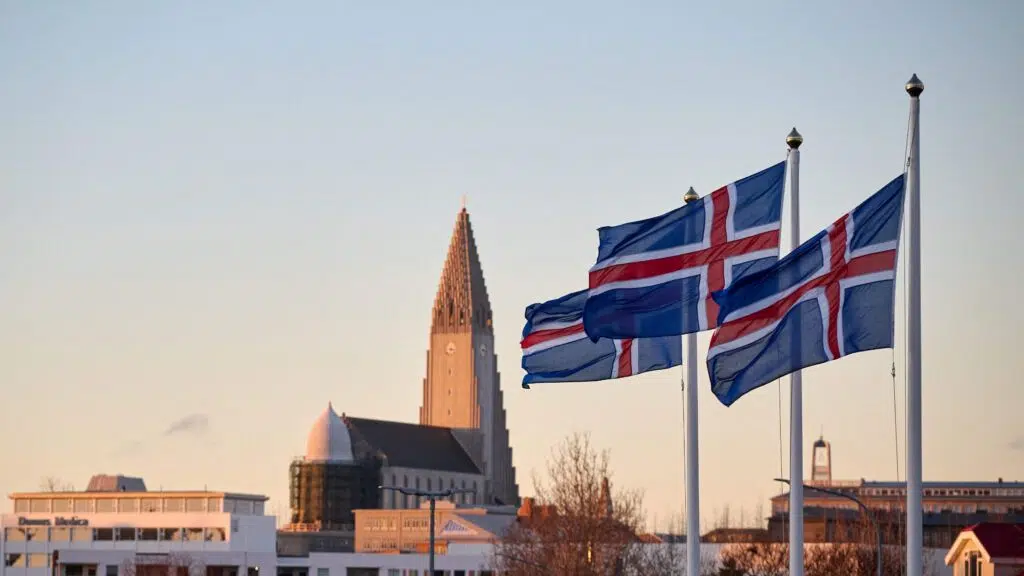
Photo c: AFP/Scanpix – downloaded from ICDS website.