This publication is originally published by International Centre for Defence and Security (ICDS)
Authors:
Steven Blockmans, Senior Fellow, International Centre for Defence and Security (ICDS), Associate Senior Research Fellow, Centre for European Policy Studies (CEPS)
Michael Emerson, Associate Senior Research Fellow, Centre for European Policy Studies (CEPS)
The EU enlargement process received a jolt of energy in the wake of Russia’s full-scale invasion of Ukraine and saw major developments in 2025.
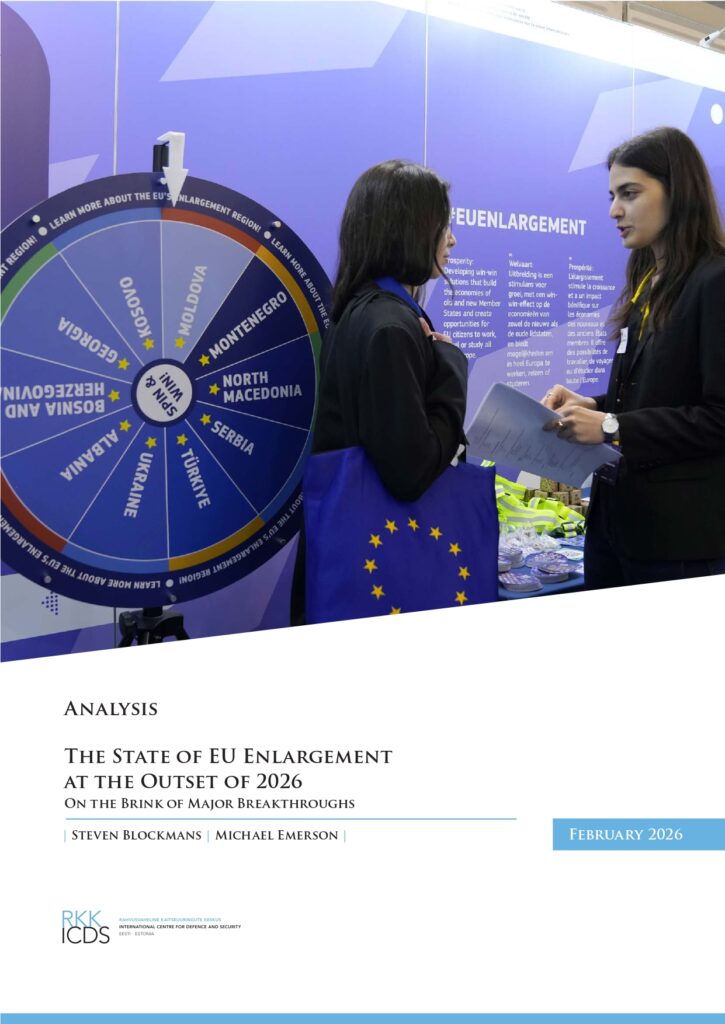
The long train of accession candidates is now broken up into four departments: (1) ‘key enlargement partners’ (to use new EU language): Montenegro and Albania, with Moldova and Ukraine; (2) laggards with lingering political issues preventing them from progressing: North Macedonia, Kosovo, Bosnia and Herzegovina; (3) backslider: Serbia; and (4) outsiders: Türkiye and now Georgia.
The four ‘key enlargement partners’ have all set out target dates, between 2026 and 2028, for completing accession negotiations, which the EU acknowledges, dates having hitherto been unmentionable. This new dynamic in the enlargement process is largely driven by the geopolitical context, including European efforts to have their voice heard in the US-mediated peace process aimed at ending Russia’s war in Ukraine. Although the prospects for a real peace in 2026 look highly uncertain, the introduction of the idea of ultra-fast accession of Ukraine by 1 January 2027 has sparked work in the Commission on how this might be devised.
For our part, we advocate for this purpose a 2-stage accession process, in which the first stage would be based on the ‘Nominated Member State’ proposal, and which could be launched at or close to the 2027 target. Otherwise, this target date would be impossible under the regular enlargement procedures. Exceptional circumstances call for exceptional measures.